Zanshin Calendar
EN RU
Donate

Zanshin Calendar

Tibetan and Japanese calendars with almanac readings, and a meditation timer

Zanshin Calendar opens on today and shows it as a Tibetan almanac or the old Japanese calendar (旧暦) would: the lunar date, what the day is good for, what to put off, and when the sun rises, stands at noon and sets where you are. Tap a line and it tells you what it means. There is also a meditation timer, a mindfulness bell and a prayer wheel.

Android 8 and later · version 3.4 · no internet permission

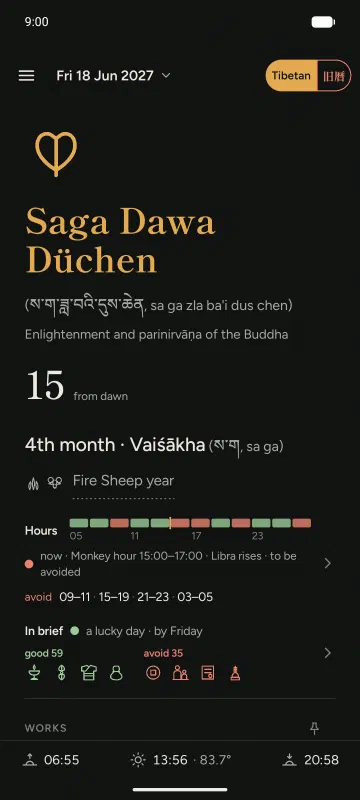
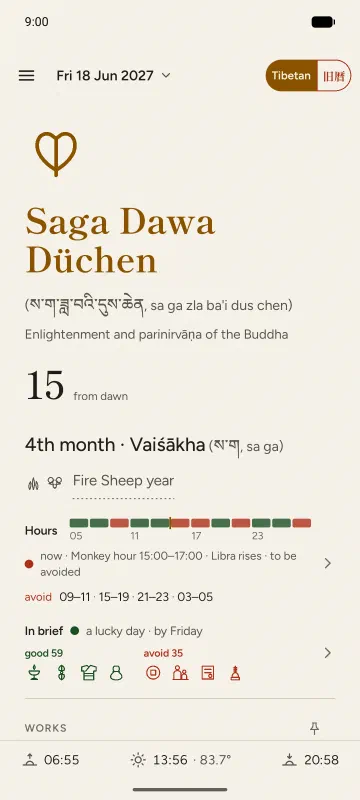
Tibetan day: Saga Dawa Düchen (ས་ག་ཟླ་བའི་དུས་ཆེན, sa ga zla ba'i dus chen), the 15th of the 4th month, the hours above the day and a lucky day in brief, with the sun's times
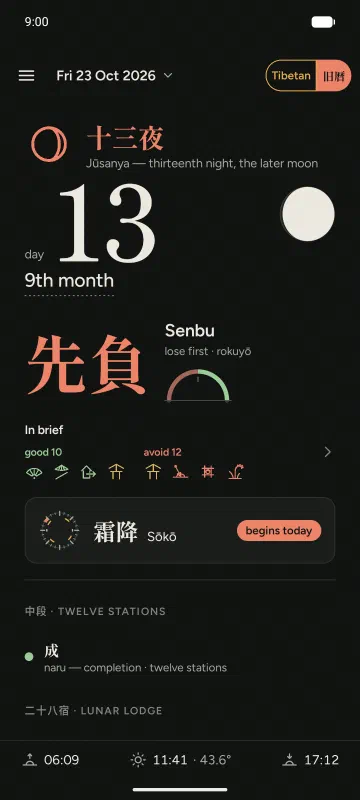
Japanese day: 十三夜, the 13th of the 9th month, 先負, and the solar term 霜降 beginning
A 旧暦 day
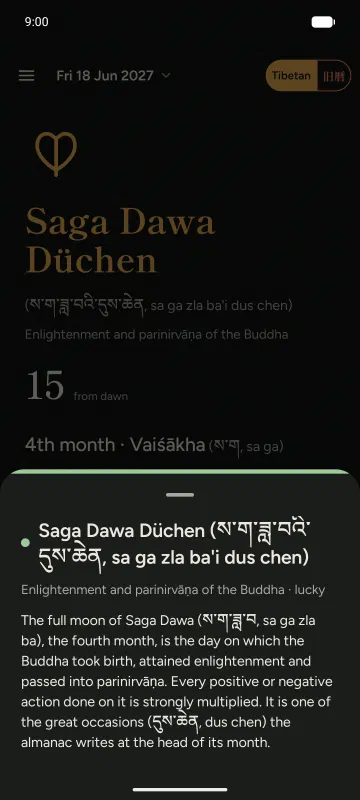
A reading opened: Saga Dawa Düchen (ས་ག་ཟླ་བའི་དུས་ཆེན, sa ga zla ba'i dus chen), the full moon of the fourth month, explained
A reading opened
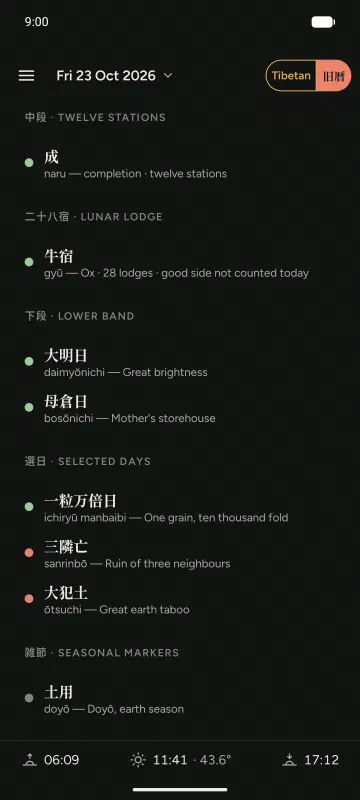
The 旧暦 almanac: 中段, 二十八宿, 暦注下段 and 選日, each entry with its English
The almanac bands
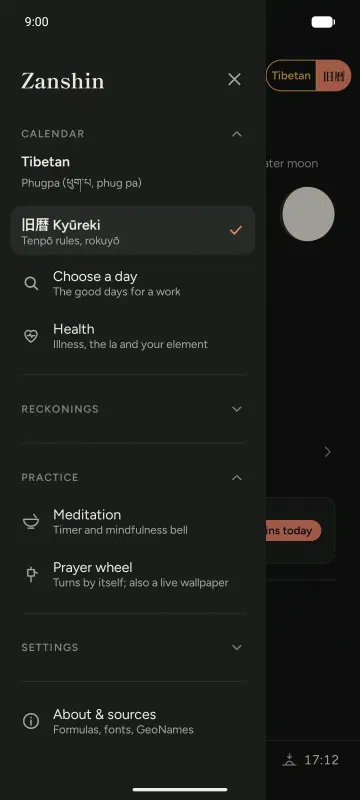
The menu in groups that fold: Tibetan or 旧暦, Choose a day and Health; Meditation; settings closed; about and sources
The menu
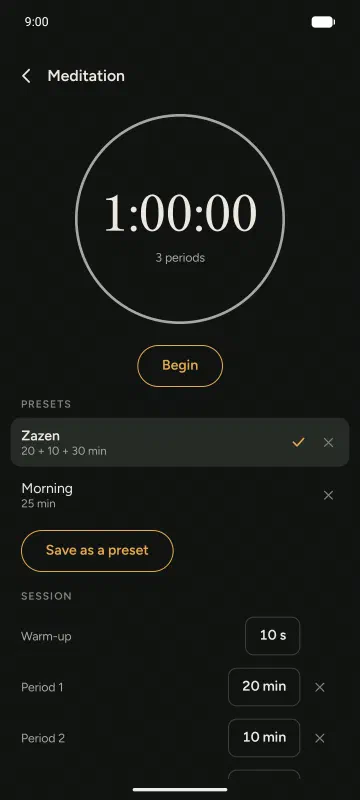
The meditation timer: a zazen of 20, 10 and 30 minutes, an hour in three periods, set from its preset, with the warm-up and each period's length below
A meditation timer
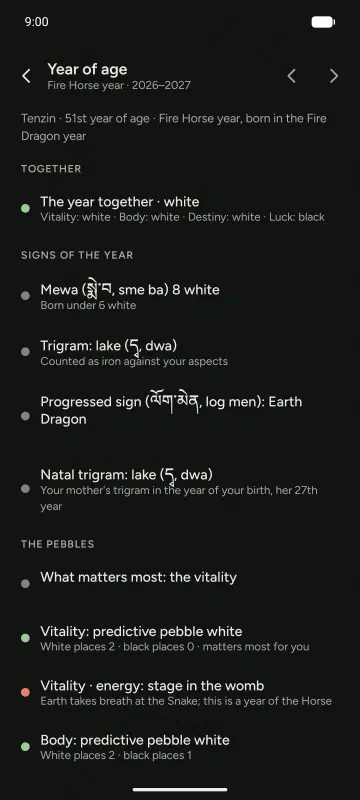
The year of age in the Reckonings, for a man born in a Fire Dragon year, now in his 51st. His mewa (སྨེ་བ, sme ba) is 8 white, his trigram the lake (དྭ, dwa) and his progressed sign (ལོག་མེན, log men) Earth Dragon. Below them stand what matters most for him, the vitality, and each aspect's predictive pebble with the stage of its energy
Your year of age
The Tibetan day of the first screenshot, Saga Dawa Düchen (ས་ག་ཟླ་བའི་དུས་ཆེན, sa ga zla ba'i dus chen), in the Paper theme: a warm light page with dark ink
Light or dark
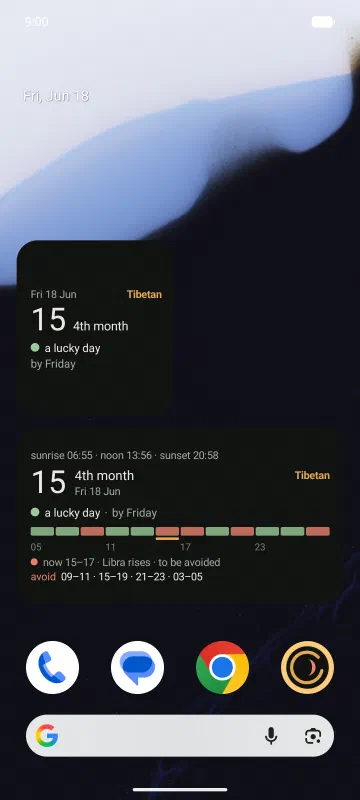
The home screen with the two widgets: Day, the 15th of the 4th month, a lucky day; and Day and hours, the twelve hours of the day with the present one marked and the hours to avoid
Widgets on the home screen
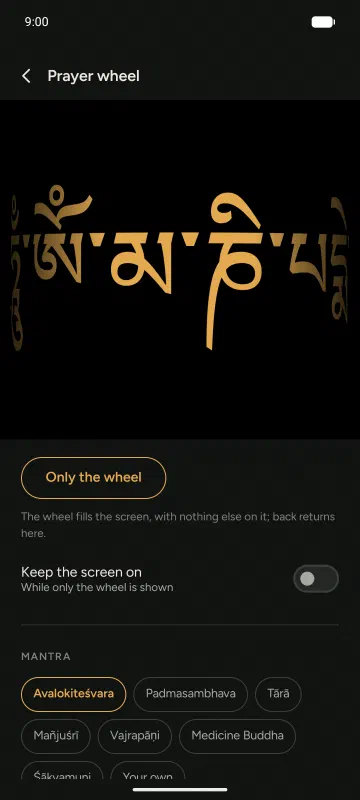
The prayer wheel: a mantra in gold Tibetan script on a turning drum, with the way to the wheel alone and the mantras to choose from below; also a live wallpaper
A prayer wheel
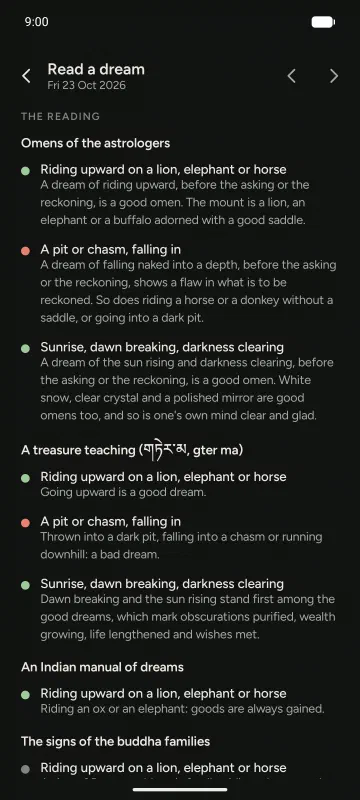
A dream read: a dawn dream of riding upward, a pit and the sun rising, each tradition's verdict on each image with its tone, under the tradition's heading
A dream read

Tibetan calendar, Phugpa (ཕུག་པ, phug pa)

  • The date: lunar day, month and year, including the days the calendar skips or doubles and the leap months.
  • Festivals

    Losar (ལོ་གསར, lo gsar), Chötrul Düchen (ཆོ་འཕྲུལ་དུས་ཆེན, cho 'phrul dus chen), Saga Dawa Düchen (ས་ག་ཟླ་བའི་དུས་ཆེན, sa ga zla ba'i dus chen), Chökhor Düchen (ཆོས་འཁོར་དུས་ཆེན, chos 'khor dus chen), Lhabab Düchen (ལྷ་བབས་དུས་ཆེན, lha babs dus chen) and others, plus the monthly observances on the 8th, 10th, 15th, 25th and 30th.

  • A day in brief

    The day's factors are weighed in the order the texts rank them, with the hours above the day. You get the tone of the day, the one factor that settles it, and what the lists call good or say to avoid. On today's page the answer follows the present hour.

  • Choose a day

    Pick a wedding, a journey, a haircut or any other work, then a span of one to twelve months. The best days come ranked, with the good hours of each month.

  • Your works

    The ones you pin come first on the page, each with what the day makes of it. The haircut sits next to them with its good and bad days and hours, and your birth year adds your personal days.

  • The hours

    A round dial of the day. It marks each hour's combination period, Jupiter's nectar periods, the earth lords of the hour and the black hours. It also says what each hour suits, where the sun's four rough times fall and which works an hour turns against the day.

11 more
  • The day's signs

    Lunar mansion, yoga, karaṇa, the element pair of weekday and mansion, and the animal, trigram (སྤར་ཁ, spar kha) and number of the lunar day. All of them have readings, and so do the special days, Rāhu's course, the earth lords and the direction of the astrologer spirit (བླ་མཁྱེན, bla mkhyen).

  • Changes within the day

    A second mansion, a skipped yoga or the span of Viṣṭi, each with its time, as the almanac of the White Beryl (བཻཌཱུར་དཀར་པོ, bai DUr dkar po) writes them.

  • Mewa and links

    The date's mewa (སྨེ་བ, sme ba) and what the activity lists hold it good or bad for. The twelve links (རྟེན་འབྲེལ, rten 'brel) are counted from the month's middle term, and each day's link comes with its works, directions and remedy.

  • The hundred feet (རྐང་བརྒྱ, rkang brgya)

    The fangs of the moon, the sun, the five planets and Rāhu when they land on your birth mansion, and the spear and great spear on the moon's mansion.

  • Month headings

    The almanac opens each month by saying if it is long or short and which planet rises. It goes on to the black months, the seven days of the sage (དྲང་སྲོང, drang srong) and of the pig, and any comet its count marks.

  • Eclipses

    Lunar and solar, found by the karaṇa reckoning (བྱེད་རྩིས, byed rtsis) of the Kālacakra (དུས་འཁོར, dus 'khor) as the almanac does it. They appear on their day with the merit they multiply.

  • The bride's going: seventeen checks for you and your spouse, on any day and when you choose a wedding day.
  • Earth lords

    A compass for the year and another for the month. They show where each lord stands, the works it bars there and the remedy.

  • The four aspects

    Vitality, body, destiny and luck for the year. With your birth year you also get the personal mansions, and the white and black pebbles of the year, month, day and every hour.

  • Health

    What it means to fall ill today, going by the date, the weekday, the link and the goddess of the day. You can see where the la, the life-spirit (བླ, bla), sits now and how it moves through the day, the day's mansion for your element and the day's medical works. The humours and seasons of the Four Tantras (རྒྱུད་བཞི, rgyud bzhi) of medicine are here too, and each element's illness with where it lies, its door and its signs. These are the tradition's readings, not medical advice.

  • Illness reckoning

    Enter the moment an illness came on. Its trigram, day animal, mewa and planet each name their spirits, ransoms and rites. Five pebbles name the illness, and the reckoning finds the kind of harmful spirit, the progressed sign (ལོག་མེན, log men), the sky year and the people the sick need. After the nineteen pebbles and the board of fifteen starting points with its four plank-trees, everything is read together and the remedies are gathered in one place.

Old Japanese calendar (旧暦, Tenpō rules)

  • The date

    Month and day with the moon's age and phase, the rokuyō (六曜), and the current solar term (二十四節気) with its reading and the ring of all 24.

  • The middle band

    The twelve stations (十二直), plus the lunar lodge (二十八宿) and the day's star of the nine (九星).

  • The lower band

    Lucky and unlucky days (暦注下段) and the selected days (選日), such as 天赦日, 一粒万倍日, 不成就日 and 三隣亡. Where the 暦林問答集 of 1414 speaks of a day, its reading is the one you see.

  • Seasons and directions

    Seasonal markers (雑節), festivals and the signs of the day and year (干支). The lucky direction of the year (恵方), the year's eight direction gods (八将神) and 金神 stand on a compass, next to the direction 天一神 takes that day and where the 大将軍 is that day.

  • Choose a day: the days the annotations call good for a work, in date order, with the disputed days set apart.

Reckonings

  • Your year of age

    The elemental divination of the White Beryl, year by year. It gives the mewa, trigram and progressed sign of the year, says what matters most for you, and lays out twenty-four pebbles with their predictions. It shows the stage each aspect's energy has reached and picks out the obstacle years, each with a reading and remedies. Then the whole year is read together: obstacles graded, remedies gathered. Enter relatives and you also get the natal trigram (སྐྱེས་སྤར, skyes spar) and the obstacles a spouse, a parent or a son brings.

  • The household round

    For a house of four or more, each member's pebbles go into the god's, people's, house's and enemy's places. When half the house shares a birth mewa, the mewa's copper vessel reads it.

  • Your birth

    What the natal trigram makes of each aspect, how glory and misfortune stand against your parents, and the line of births from father and grandfather. The birth year is described by its animal, its place among the sixty years, its body and its mewa. A hundred pebbles go on a board, and twenty of them decide. Other readings ask whether the child will be hard to raise and how destiny stands against life force. Everything is then read together with the remedies gathered.

  • Marriage match

    The app sets two people side by side, beginning with their bad years, the four aspects, the two destinies and the pairs of year animals, and moving on to the birth mewas, the natal trigrams if you have entered both mothers, and each life force on the other's year. It also looks for smaller things, like whether the match is reversed, what is hidden in the aspects' mewas and the number of siblings, before reading the match as a whole and gathering its remedies.

  • A relative who has died

    The deciding pebbles of the four aspects say whether the time of death had come, and from there the reckoning finds the reason the death met, which spirit carried the dead off, where they are reborn and how virtue can help them. For the old it names their kind, and for everyone it says who should not handle the corpse and at whom the death's eye looks. For each person you get the rites and provisions in one list.

  • Circles and starting points: the thirteen circles and the thirty starting points of your year.
3 more
  • Small reckonings

    The four starting points of the spiritual friend, the ministers, the soldiers and the weapons, then the rounds by age for a man or a woman, which have names like the peacock, the rhinoceros and the cock's black trail. There are also the years when the la wanders or declines, the grave entered, the end of the womb and your birth by the year's power.

  • The present moment

    Its trigram and mewa, then your house, field and grave against the moment's sign. Wealth, food, trade, disputes, the sick, beer and the neighbouring houses each get a reading. Further on are the nine squares, the thirteen gates and the fighting enemies. Then come the signs to watch for: dreams, how the asker comes and sits, omens on the road, voices and callers. The fighting enemies' verdict and the wealth close it, with the remedies gathered. Two more questions sit here: the month to ask after someone gone abroad, and the signs of the month, date and hour.

  • Read a dream

    Tell the app when last night's dream came, at dusk, in the middle of the night or at dawn, or give the clock time. Only the dawn dream is read. Tick its images from 94 in groups, and each tradition that reads an image gives its verdict in its own row, with a remedy for a bad one. The dream is never summed into one verdict, and no date is set for its fruit. If the dreamer is ill, the medical readings and their own rule of the night come in.

Meditation

  • Timer

    A warm-up and periods of any length in one session, say a zazen of 20, 10 and 30 minutes. The bowl sounds at the start and end, the wood block between periods.

  • Presets: save a session and set it again with one tap.
  • Screen off or on

    The timer keeps time with the screen off and puts the countdown and a Stop button in the notification. If you prefer, the screen stays on from Begin until you leave the timer.

  • Mindfulness bell

    Pick how often it rings, anywhere from every 15 minutes to every 2 hours, at fixed or random times, and which hours and days count. A silenced phone, a call, music or a video keeps it quiet. While it rings you see a notice with your own message.

  • Sounds

    Two bowls, large and small, a bell and the wood block. The phone makes them itself, so the app carries no sound files.

Prayer wheel

  • The wheel turns slowly on its own and shows a mantra in Tibetan script, with nothing drawn around it: tap to nudge it faster, swipe to send it spinning, hold a finger on it to stop it
  • Pick one of seven mantras or type your own line, and that line can turn counter-clockwise if that is what your lama gave
  • Drum from the side or ring from above, in the colours you choose
  • Only the wheel: everything else goes away, and the screen can stay on if you ask
  • Live wallpaper: the same wheel on your home screen, and it draws only while you can see it
Terms you can open

Tibetan words carry their English, script and Wylie, and a tap adds how to say them. Kanji give their English on a tap. An almanac line opens to what it means, what it favours, what to avoid and how to remedy it. The readings all come from published sources, listed under About & sources.

Glyphs and dials

The little glyphs are there for a quick look at what the day favours and warns against. Inside the readings, dials, rings and boards show where a term stands in its cycle.

Languages: English and Russian, set in the menu or taken from the phone.
Themes

Ink is the dark default, Paper a light page with dark ink, Night black for OLED screens, Maroon the robe's colour with saffron, and Sepia a parchment page for the evening. The app can also follow the phone's own dark or light setting.

Large fonts and wide screens

The pages follow the phone's font size up to twice the default. In landscape or on a tablet they stand in two columns, with the day at a glance beside its sections.

Morning notice

Turn it on and you get one silent notice a day, at the time you set, for the calendar you last read. The Tibetan page gives the day's tone and what decides it, how many works are good or to avoid, and the hours that run against the day. The 旧暦 page gives the rokuyō and the day's mark. A tap opens the day.

Widgets

Two for the home screen, in the app's theme and language, showing the calendar you last read. Day has the date, the day and its tone with the factor behind it; for the 旧暦 it has how many works are good or to avoid. Day and hours adds the twelve hours of the Tibetan day in the colours of their verdict, with the present hour marked and the hours that run against the day. If it is tall enough you also get the sun's times and your own day. For the 旧暦 it shows the rokuyō and the day's mark. A tap opens the day.

Computed on the phone

Everything is calculated on the device for any date from 1900 to 2100. Tibetan dates use Svante Janson's published arithmetic, and new moons and solar terms use Jean Meeus's algorithms and the VSOP87 solar theory. The results are checked against Edward Henning's Tibetan calendars and the National Astronomical Observatory of Japan.

Private

The app has no internet permission. You give it your location by GPS once, when you ask, or by picking from an offline list of cities, or by typing coordinates. It stays on the phone.

Sources

Every reading comes from a published book, table or almanac, and About & sources in the app lists them. The formulas and test vectors are in the specification.

New in 3.4

Read a dream, in the Reckonings: choose the part of the night or give the clock time, and tick the dream's images. Only the dawn dream is read: each tradition gives its verdict on each image, with one remedy for a bad dream, and nothing is summed. "The dreamer is ill" brings in the medical readings and their rule of the night. The clan is no longer asked. Anurādhā's good list now has rites for long life.